
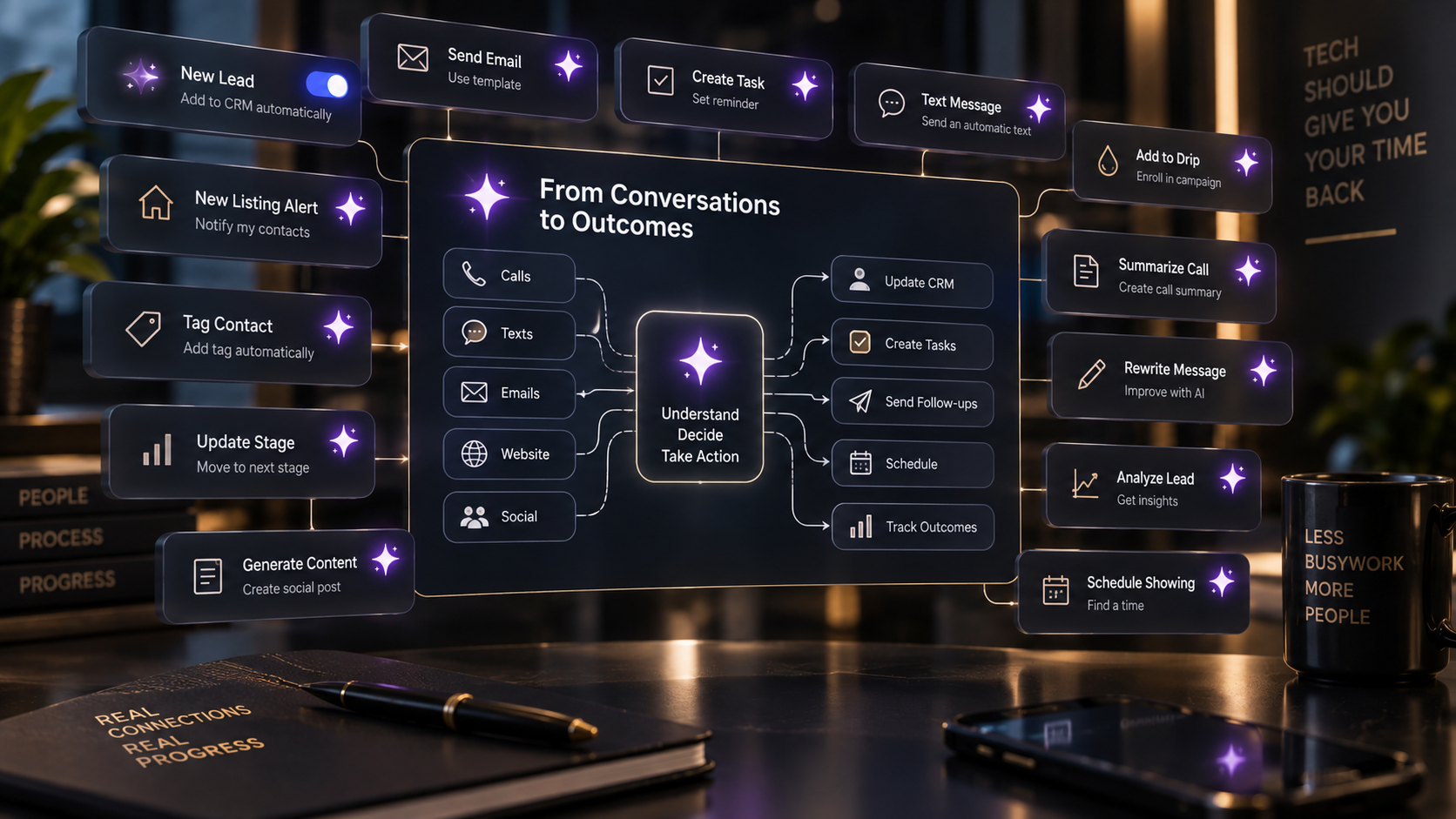
You know the symbol.
A couple of little sparkles appear beside a button, feature, or notification, and before you’ve even read the words next to them, you already know what you’re supposed to think:
AI.
No standards body declared the sparkle the official symbol of artificial intelligence. There was no industry vote. Software companies simply began using it, users learned what it implied, and now it appears everywhere.
That might seem harmless.
It isn’t.
Because the same visual language is increasingly being placed beside capabilities that range from simple rules-based automation to generative assistance to systems capable of actually interpreting context and deciding what should happen next.
When all of those things look like AI, the word starts to lose its meaning.
And for an industry like real estate—where agents are currently being promised AI in nearly every piece of technology they use—that distinction matters.
A Useful Feature Doesn’t Have to Be AI
A recent example from Follow Up Boss illustrates the issue well.
Follow Up Boss introduced an Auto Outreach experience designed to identify lead sources that don’t have automatic follow-up configured and help users set up initial text messages.
The interface uses the now-familiar purple sparkle imagery prominently beside the feature.
The underlying concept is straightforward:
A new lead enters from a particular source. A message is prepared for that source. When the appropriate event occurs, the system sends the message.
That’s automation.
And there’s absolutely nothing wrong with that.
In fact, good automation is incredibly valuable. If a system can ensure that a new internet lead receives an immediate response instead of waiting two hours for an agent to notice a notification, that’s useful technology.
Follow Up Boss’s own announcement describes automated first texts as a capability that already existed in the platform, while the newer experience makes setting them up easier.
The distinction becomes important because AI may still be involved somewhere in that experience. A model might help suggest the wording of a message, recommend which lead sources need attention, or assist with configuration.
But adding intelligence to one part of a workflow doesn’t necessarily transform the entire workflow into an intelligent system.
That’s where today’s software marketing is becoming increasingly blurry.
Automation and Intelligence Aren’t the Same Thing
For years, software has been very good at following instructions.
When X happens, do Y.
A lead comes in, send a text.
A contact reaches a certain stage, start an email campaign.
A task reaches its due date, send a notification.
A form is submitted, assign the lead.
Those workflows can save enormous amounts of time. They should continue to exist.
But they’re deterministic. A human has generally decided in advance what event matters and what the software should do when it occurs.
Artificial intelligence introduces a fundamentally different capability:
Interpretation.
Instead of simply asking whether a predefined trigger occurred, an intelligent system can potentially ask:
What happened? What does it mean? What changed? What should happen because of it?
That is a very different problem.
Yet increasingly, both experiences receive the same sparkle.
We’re Collapsing Four Different Things Into One Word
Part of the problem is that “AI” has become an umbrella covering technologies that behave very differently.
Consider four levels.
1. Automation
When X happens, do Y.
A new Zillow lead arrives. Send the Zillow lead template.
The software doesn’t need to understand the lead, the message, the person’s situation, or why the action is appropriate. It needs to recognize the trigger and execute the configured rule.
That’s automation.
2. AI-Assisted
When X happens, use a model to help create or determine Y.
Perhaps the system generates a personalized first text instead of inserting a predefined template.
Now intelligence is participating in the workflow.
But the workflow itself can still be predetermined:
New lead → generate message → send message.
That’s meaningfully different from traditional automation, but the software still isn’t necessarily deciding what objective should be pursued.
3. Intelligent Systems
Now the system begins interpreting context.
Imagine an agent finishes a 15-minute conversation with a buyer.
During that conversation, the buyer mentions that she’s getting married, her fiancé will be purchasing with her, they’re currently renting, they’d like three bedrooms, they need a fenced yard because of their dog, they’re targeting a particular school district, and they’d like to move before their lease expires.
There isn’t one simple trigger in that conversation.
There are dozens of interconnected facts.
An intelligent system should be capable of understanding them, determining which information matters, connecting it to the correct people and records, recognizing changes from what was previously known, and preserving that context.
The software isn’t merely reacting anymore.
It’s understanding.
4. Agentic Systems
There’s another step beyond understanding:
Doing.
Suppose that same buyer tells the agent:
“I’d really like to see that house we talked about. Tuesday around four would be perfect.”
A genuinely agentic system isn’t valuable merely because it summarizes that sentence.
It needs to understand the objective.
It may need to identify which property they’re discussing, determine how that property’s showing process works, check the agent’s availability, initiate whatever actions it’s authorized to perform, wait for responses, react to approval or denial, and involve the agent when something requires human action.
Most importantly, it has to recognize that the job isn’t finished simply because it performed an action.
The objective is getting the showing scheduled.
That difference—between executing a trigger and pursuing an outcome—is enormous.
The Sparkle Makes Those Differences Invisible
Now put the same ✨ next to all four.
To the person using the software, they begin looking equivalent.
They’re not.
One follows a rule.
One generates something.
One understands something.
One pursues an objective.
That distinction matters because agents are making real purchasing decisions based on what they’re being told these systems can do.
If importing a lead automatically gets an AI badge, generating an email gets an AI badge, summarizing a phone call gets an AI badge, and an autonomous workflow gets an AI badge, how is an agent supposed to know what they’re actually buying?
That’s the Sparkle Problem.
This Is Bigger Than Follow Up Boss
Follow Up Boss is simply a visible example of a much broader software trend.
The issue isn’t whether a particular Follow Up Boss feature contains AI somewhere behind the scenes. It very well may.
The issue is that the software industry has increasingly adopted a visual shorthand that communicates “intelligence” without communicating what kind of intelligence is actually present.
And real estate technology is particularly susceptible to it.
Nearly every established category is being repositioned around AI.
CRMs have AI.
Website platforms have AI.
Lead-generation companies have AI.
Marketing platforms have AI.
Transaction systems have AI.
Email tools have AI.
Sometimes those capabilities are genuinely transformative.
Sometimes a language model has simply been inserted into an existing feature.
And sometimes a feature that has existed for years receives a new interface, some generated suggestions, and a sparkle.
Those shouldn’t all mean the same thing.
AI Washing Eventually Hurts the Companies Doing Real AI Work
There’s a longer-term consequence.
When every software company describes increasingly ordinary functionality as AI, expectations rise while meaning falls.
Users eventually experience enough “AI-powered” buttons that don’t materially change their work that the label stops being impressive.
We’ve seen this happen with technology terminology before.
“Smart.”
“Cloud.”
“Automated.”
“Machine learning.”
Eventually, the terminology becomes marketing wallpaper.
AI is heading toward the same fate.
And that’s unfortunate because the underlying technological shift is very real.
Software is gaining the ability to interpret enormous amounts of unstructured information, maintain context, reason across systems, interact through natural language, use tools, and increasingly perform multi-step work toward objectives.
Those capabilities could fundamentally change how professionals interact with software.
But that transformation becomes harder to communicate when changing the wording of a text message and operating part of a business are represented by the same sparkle.
We Should Be More Precise About What Software Actually Does
The solution isn’t complicated.
Call automation automation.
It’s valuable.
Call generative assistance generative assistance.
It’s valuable too.
When software interprets context, describe what it understands.
When software makes decisions, explain what it’s allowed to decide.
When software takes actions, explain what it can execute.
And when software is truly agentic, hold it to a much higher standard than whether it can generate a clever response.
The important question shouldn’t be:
“Does this feature use AI?”
Increasingly, almost everything will use AI somewhere.
The better questions are:
What does it understand?
What can it decide?
What can it actually do?
What happens when something doesn’t go according to plan?
Does it know when it needs a human?
And how much work does it actually remove from the person using it?
Those questions tell us far more than a sparkle ever will.
Intelligence Should Reduce the Need to Manage Software
This distinction is important to what we’re building at Reluxity.
We don’t believe the future of real estate technology is about putting an AI button beside every feature.
And we don’t believe success should be measured by how many places we can put a sparkle.
The bigger opportunity is changing the relationship between the agent and the software itself.
For decades, agents have worked for their technology.
They enter the notes.
They update the contact.
They change the stage.
They create the task.
They schedule the follow-up.
They build the automation.
They remember which system contains which information.
They tell the software what happened, and then they tell it what to do about what happened.
Intelligence gives us an opportunity to reverse that relationship.
The agent should be able to have a conversation with a client and trust that the system understands what happened.
It should understand the people involved.
The relationships between them.
Their preferences.
Their plans.
Their constraints.
Their commitments.
And eventually, it should be capable of determining what needs to happen next, executing what it’s authorized to execute, tracking unresolved objectives, and bringing the agent back into the loop when human judgment or action is actually required.
That’s a much bigger idea than adding AI to a CRM.
It’s part of the reason we’re building Reluxity as a Real Estate Agentic Operating System—RAOS.
Not because “agentic” is the next label we want to put on existing software.
Because the standard should be higher.
The Sparkle Isn’t the Future
There will probably be more sparkles before there are fewer.
AI is the defining technology story of this moment, and software companies understandably want customers to know they’re participating in it.
But eventually, the icon won’t matter.
Neither will the label.
Users will care about what the technology actually accomplishes.
The winners won’t be determined by who managed to put the most AI symbols throughout an interface.
They’ll be determined by whether the technology can understand the real world around the user and meaningfully reduce the amount of work required to operate within it.
The future of real estate technology won’t be defined by how many features have a sparkle next to them.
It will be defined by how much the software can understand, decide, and accomplish without making the agent manage the technology.